 Aureus Arcus Advising
Welcome to Thoughts and Threads
I will occasionally post some thoughts here or give you a thread upon which to pull to see what you can unravel.
Taxonomy helps with IT planning!
Taxonomy is the process of classification or the study of the process itself. Usually we classify items using one or more hierarchies. For example in accounting we use the chart of accounts to classify the nature of an item (the what) and the organizational hierarchy to classify which part of the organization is responsible for the item (the where).
Taxonomy helps us organize our knowledge and look for gaps. The gaps in the Periodic Table of the Elements helped scientist discover new elements. Gaps in the Standard Model of physics led to the discovery of new particles.
We can use the classifications we’ve established to help brainstorm new ideas. For example Porter’s model of competition categorizes competitive threats (see Porter’s Five Forces on Wikipedia). We might brainstorm threats from substitute products — if we were a computer hardware vendor some years ago we might have identified cloud computing and factored this into our thinking. Read More
Are you Plexecuting?
Plexecution was a term I first heard from the woman who ran the Program Management Office in an IT organization I led. I’m not sure if she coined the term but it was her way of asking whether we had done sufficient planning or whether we had launched into execution and then decided we really ought to do some planning.
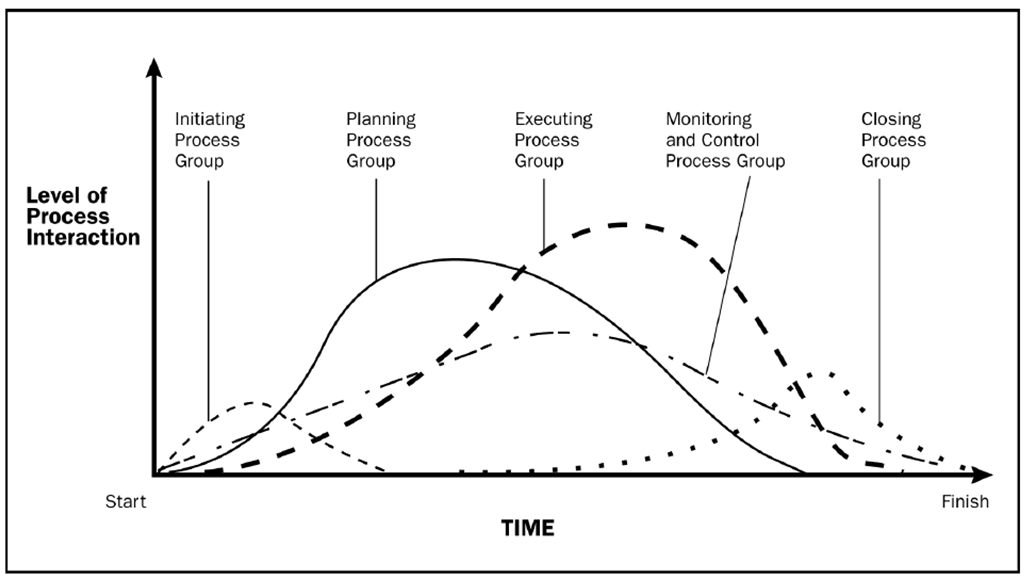 Now planning ought to continue through out a project so there is nothing wrong with some degree of plexecution. Deming’s famous plan, do, check, act mantra emphasizes the need to re-plan during the check, act part of the cycle. The Project Management Body of Knowledge illustrates that planning should occur to some degree through the life of a project as illustrated by the attached diagram from PMBOK version 3. However when the hump of the planning effort coincides with or lags the execution hump you are plexecuting to a dangerous degree. We all know that planning is inexpensive compared to the rest of the project and eliminating flaws in our projects through good planning is a very wise investment. Read More
Do you have too many IT projects on the go?
How many IT initiatives should you have on the go at any one time? Not a simple question to answer but you need to consider the trade-offs between resource utilization and elongation of individual projects.
Let me illustrate the consequences of poor optimization through a simple example. Let’s suppose I have one IT analyst at a cost of $100,000 per year. I have five projects I wish to undertake each requiring one person year of effort and each producing $150,000 of benefits per year starting the year following project completion. Let’s look at two scenarios. First we undertake each project serially. At the end of the first year I start reaping the benefits of the first project. In the second scenario I work on all five projects simultaneously and (assuming no switching effort) I will reap the benefits of all five project starting in year six. Read More
What shape are your inter-enterprise relationships?
 How do you line up with your key trading partners? Do you have a single point of contact between your two organizations, say a buyer or category manager and their sales rep? Or do you have much broader and more effective relationships?
Business processes and the flow of money, goods and information can span one or more organizations. By broadening your relationships you can ensure that these work smoothly and that any problems are caught early and solved without escalation, misunderstandings, frayed nerves and damaged relationships. Read More
Does your IT Plan support your organization’s innovation agenda?
By this I mean how your organization uses IT to support its innovation agenda not how innovative your IT organization is in the delivery of its services — although that is important too.
In IBM Global CEO Study 2006 Expanding the Innovation Horizon, CEOs considered three forms of innovation:
- Business model – Innovation in the structure and/or financial model of the business
- Operational – Innovation that improves the effectiveness and efficiency of core processes and functions
- Products/services/markets – Innovation applied to products or services or “go-to-market” activities.
All are important but at the time of the study CEOs were increasingly focused on business model innovation. As an IT leader do you know what is on your organizations innovation agenda? Does your IT plan recognize and support innovation and does it lay the foundation for change? Read More